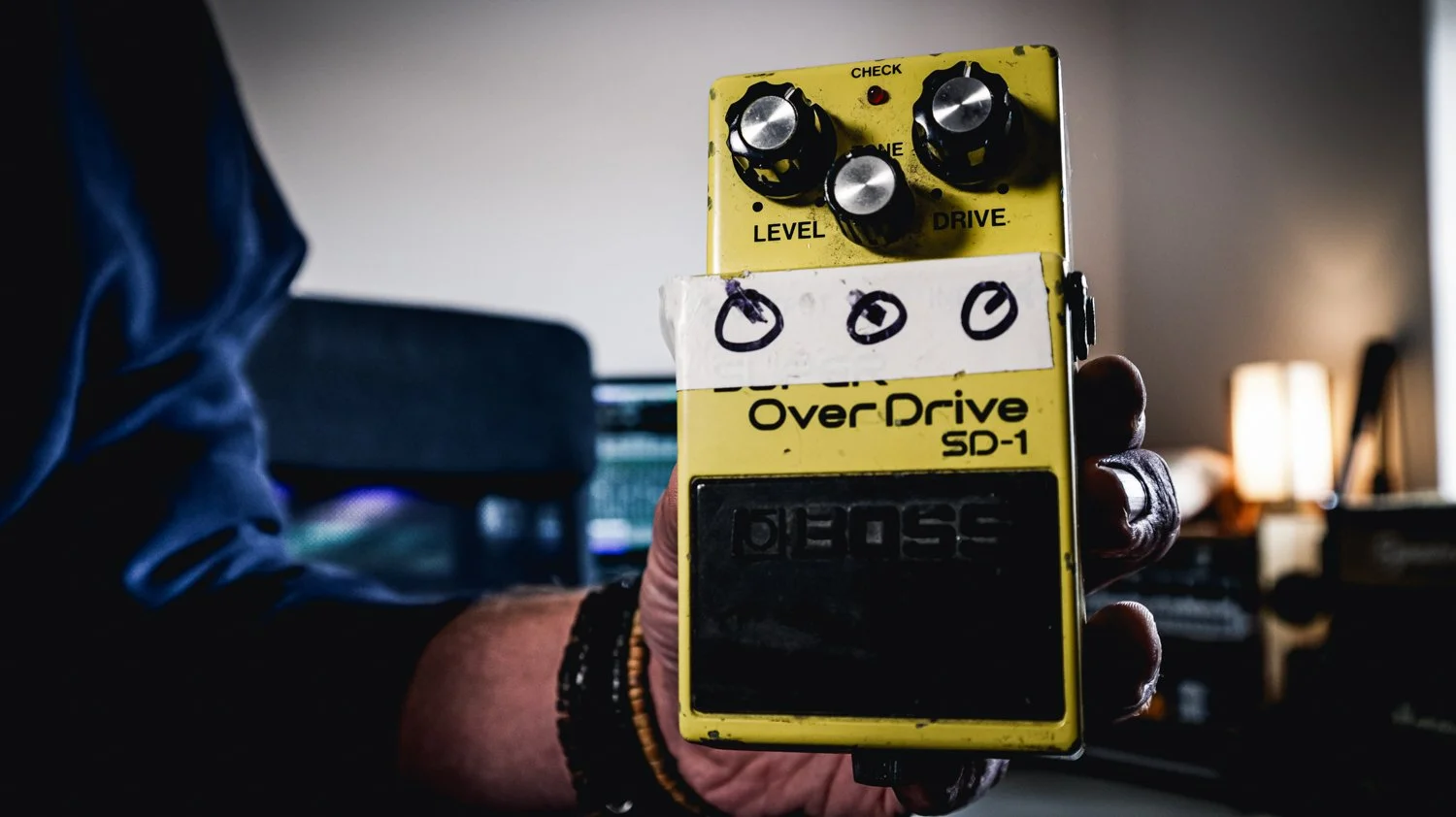
As a guitarist you realise that overtime, there are pedals that come and go. There are the boutique wonders with their hand-painted graphics, the endless parade of cheap and ludicrously expensive clones, the supposedly “transparent” drives that promise to unlock some hidden truth in your guitar tone and your soul (if the internet is to believed #gamechanger). And then there’s the old Boss SD-1, and it is yellow.
I’ve had mine for nearly thirty years. It’s a small, battered yellow box, the paint chipped in the way only Boss enclosures seem to wear, a bit of electrical tape which seems to have fused with the case and around the edges the corners appear to have rounded off through the passage of time and the abuse of being stomped on year after year. The rubber tread on the footswitch has smoothed with use, and there’s dust an general gig greeb which you can never quite scrub out of the ridges.
When I first got it, it wasn’t a big purchase, although I had saved up doing a live sound gig to get it. The SD-1 was never really an expensive pedal (although it felt like it at the time £30). It was the also the kind of pedal you might find second-hand in a magical glass cabinet in the back of a guitar shop (remember them!), stacked alongside DS-1s, CE-2s (original ones!), TU-2s. But I needed to rock, so I needed an overdrive, it is what you had, it was always the first dalliance with pedals, you couldn’t be a guitarist without Dirt, and the DS1, well it was orange!. With the SD-1 there was something about the colour, about the simplicity, that drew me in. I certainly wasn’t chasing tone-shaping b*llshit philosophies back then. I just wanted to rock, but was limited by the power of my amp. I needed something that would make my amp (and my playing) destroy.
And that’s exactly what it did.
The Familiar
The SD-1 has was and never been about those BS marketing boutique adjectives and platitudes that seem to accompany every press release and instragram post. It doesn’t have “warmth” or “air” or “amp-like breakup.” It just has gain in the form of asymmetric clipping, that other thing that people write essays about online. But gain and ‘pushing the front of an amp’ never felt like a spec to me, it was an embodied sensation, it felt like a….well I am not sure I could say on a public forum. I would just strike a chord, roll the volume up, dig in with my pick (Dunlop Jazz III red if you care): and it responded and I responded and the world disappeared. I was in a non-descript hall physically, but mentally I was a guitar god playing to an endless crowd.
Over the years I have run the SD-1 into practice amps (yeah not the best), into solid-state combos and racks (my beloved JMP-1 preamp), into tube amps when I could. Always the same: it just worked, no nonsense, no ego, just a great sound. A sound that no matter how many pedals I have owned, always ends back on the board. Of course, I would never say it was “perfect,” but it never got boring, never got sold on. It was slightly ragged, slightly thin, sometimes could even be a little harsh. But that was its sonic honesty, it wasn’t trying to be the mythical “transparent overdrive.” It was just the SD-1.
Thirty Years of Context
What’s strange is realising how the world of gear has changed around it, I guess this is showing mine and it’s age. When I first started using the SD-1, it was just another pedal from a very limited selection of pedals, inf fact pedals weren’t really even a thing. There was nothing mythical about it, Overdrive or Distortion, take your pick. Then of course thanks to the internet and the creation of bizarre pedal based mythos, boutique culture exploded. Suddenly, in every forum or YouTube video every circuit was analysed, cloned, re-boxed, or ‘modded’ and then marketed as the secret ingredient. Pedals became about exclusivity, waiting lists, the illusion of scarcity, ironically by people who perhaps should have spent less on pedals and more on lessons. (no it is always the pedal holding back your playing, never the fact you have never practiced….new pedal…better player)
Meanwhile, the my SD-1 just kept going, and Boss kept making them, seemingly cheap, ubiquitous, reliable and yellow. Like any Boss pedal you could drop it, spill beer on it, power it with a dying battery, drive over it with a car and it would still cough out overdrive.
I’ve used mine at gigs where nothing else worked properly, and it got me through. I’ve tracked guitars in studios around the world with it (even direct once in Cyprus….it didn’t sound good!), and its sound sits in mixes without fuss. Over the decades, other pedals came and went, but the SD-1 stayed on the board. Not out of nostalgia, but I guess out of trust.
A Pedal as Companion
After thirty years, I realise I don’t think of the SD-1 as a pedal anymore. It’s just part of my guitar presence. A companion. A bit of gear that has absorbed memory, sweat, dust, vomit (not mine!), pub grime, memories and time.
The thing is, that I realise now that when I step on it, I’m not just hearing ‘overdrive’. I’m hearing every rehearsal, every half-formed song idea, every small gig where the room buzzed with bad electrics, every late night, every journey in the back of a van, every attempt to put it in front of an amp trying to get the right feel. My SD-1 is a haunted box now, my own personal hauntological artifiact. A box not haunted by ghosts of vintage circuits, but by my own past and perhaps the lost futures I once dreamed of. The pedal is a continuity through decades of change.
The Point of all this…
If you ask me to “review” the SD-1, I can’t. It doesn’t make sense in the language of reviews. It isn’t “better” or “worse” than the countless overdrives I’ve tried since. It doesn’t win in blind tests, or in shoot-outs on YouTube. But after nearly thirty years, it’s still here. Still on the floor. Still doing its thing and perhaps that’s worth more than all the adjectives in the world.