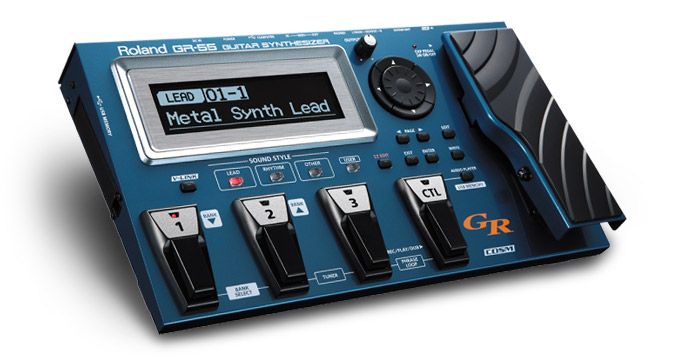
I will start off by saying that this is NOT a total in-depth review of all the features of the GR-55, as it is an IMMENSE product! There are just too many options and possibilities that you can set-up with this unit, I think it would be impossible to fully detail all of them. I am taken a-back by how powerful the GR-55 is, and with all gear with this level of depth, it can take a long time to fully discover everything about the unit (if you ever do). Needless to say the more you put in, the more you get out with something like this, but it is VERY easy to get started and to me that is one of the selling points of the unit. You can go as deep into the unit or as shallow as you like and still be impressed with everything on offer.So this review is more of a review of my experience of the unit and what I have come to like (and dislike about using it), I will not be able to cover everything that the unit does (I am still discovering myself even after owning it for ages!). So what you will get here is my experience of using it and I hope that they are of use to you. There is also the possibility that some of the things I point out as maybe negative, might actually have a better solution, I just haven't found it yet and would love to hear your thoughts.First things first, to get the unit up and running you need to install the GK-3 HEX pickup on the guitar which makes all the magic work. This pickup works using a similar principle to traditional guitar pickups, except it converts the voltage output into digital MIDI data (consisting of pitch, velocity, note on, note off data etc). The special cable not only allows for the transmission of MIDI data, but also the signal from your guitar too, which can be processed using the in-built modelling too (amps and FX's). This combination can lead to some very interesting and innovative sounds. One of the biggest problem with MIDI guitar systems, apart from tracking (tracking refers to the time delay and accuracy of note output from the unit), is spurious triggered notes and pitch issues. A lot of these problems can be overcome by the correct installation of the pickup.Installation of the GK-3 pickup. This wasn't too bad, a little bit fiddly but if I can do it....anyone can! My advice here is find a good space to work in, and separate all the parts before you begin. If you follow the instruction manual to the letter, you should have no problem. I should add that I only mounted mine using the sticky pads and it isn't drilled directly into the body. Firstly, I couldn't bring myself to drill into my guitar and secondly I wanted to be able to sell it, should I not be happy with it. I recommend that if you are going to drill it, check out the internet for videos and the like of the best way of doing it.....good luck! The next job is to ensure the high of the pickup is consistent (depending on the profile of your guitar and bridge) and this is achieved by turning a small screw on the pickup itself. With the pickup installed and the unit mounted on the guitar (you only have to remove the strap button and it fits straight on there) you can set up the string sensitivity and other attributes relating to how the pickup responds to the the string movement. These are all faily straight forward and with a bit of a tweaking it all seems to work perfectly. I have noticed that on the guitar I have sacrificed for the pickup, I initially had 9's on it and these are a little light and did result in some ghost notes and false triggers. Moving up to 10's and most of these problems disappeared.I will state one very important thing to bare in mind, as a player this device requires you probably to play 'cleaner' and more precise. I think this is a good thing, you might notice at first that you are triggering random notes or noises, when you investigate you might discover this is down to your picking hand hitting random strings (when muting perhaps) or imprecise bends causing random sounding notes. This is a great exercise in making one slow down and concentrate a little bit on technique. Of course, if you are just using the amp modelling, COSM guitar modelling, your playing will be whatever your playing is!In UseI found the user interface of the GR-55 to be extremely easy to get my head around, the manual (in true Roland fashion) is a little bit of a harder read, but they Roland are getting much better in that respect!! Of course, you will need to spend a lot of time pressing buttons to move between pages and parameters, but with the big scroll wheel and lovely screen it isn't too much of a problem. Of course if you can, download the Editor software and you can then do everything on your computer. I would also recommend downloading the librarian software as this makes patch management and installing some fantastic patches from the Roland website (and others) a breeze.I found that using the unit as a traditional guitar processor generally fine, although I would have like to be able to perhaps switch more than one pedal on and off (via the CTL) mod switch, maybe to control an overdrive pedal and mod pedal, but hey I you can do this with two patches, it isn't the biggest deal in the world. I should mention that the MOD pedal can be assigned to different functions for each patch. This is really cool as you can control parameters such as volume, wah, modulation effects and delay and blend between layers.With editing you can go very, very deep and create amazing instruments, combining the guitar's pickup, a modelled guitar and two PCM tones, which can then be blended in. Imagine something like your normal guitar running through a Marshall Amp, with a Banjo, a Koto and massive saw synth, or your guitar running through a Fender Tweed, a Telecaster with a DADGAD tuning, a string section and a ballad piano! You are pretty much only limited by your imagination, and whilst the synth engine on the GR-55 doesn't allow the depth of synthesis as you might get on an actual synth, it is not to shabby either! Adding the MIDI out into the equation, you can then have access to an external sampler, synth or virtual instrument, that is simply mind blowing!! I have lost hours playing around with all the possibilities, for me as well, it is a sound design dream because playing on the guitar gives you a different style of trigger input into the system (i.e different from the way you might play on a keyboard). But if you aren't into doing loads of editing or want to get started straight away, there are some great patches (and some dubious ones!!) and there is an easy edit option called EZ Edit (similar to that on other Roland/Boss gear like the GT-10 and ME-70 for example). This allows you to control the amount of effect or dial in a brighter or warmer sound, very...erm...well easily!Playing the guitar and changing patches is very easy via the footswitches, and the small buttons on the GK-3 enable easy switching between banks. Watching many of the demos online, to get a flawless performance, it requires the user to put their patches in a logical order, and this is easily done via the GR librarian. I have seen some frustration from users (not just with this unit but other gear like the GT-10 or ME-70 or HD500) that when they watch a performance demo online that the perform seems to switch seamlessly between patches in the song. This does require preparation, and as with all things in life, a little bit of preparation goes along way, and the same can be said with this unit. Of course, you could use an external MIDI controller to switch between your patches (something like the Roland FC-300, Behringer FCB-1010 or Tech 21 Midi Moose) or even better than that if you are a solo performer working with backing tracks, you could get your patch changes triggered via MIDI from a DAW along with your backing track playback. That is pretty cool!SoundsWith the GR-55 not only do you get a selection of synth sounds, from pianos, brass, strings and other typical synth stuff you get access to COSM modelling of guitars too. These range from types of guitar (Strat, Tele, Banjo, Acoustic, Nylon) to tunings (awesome!! The tuning options are great Drop D just like that...that is pretty fantastic!) to pickup positions and types! It is actually pretty mind blowing what you can potential do. I think the COSM guitars sound amazing, I really really love the acoustic guitar, it is perfect for me. Blend this with some strings and I could be playing for hours and hours (and to me that is the mark of a good piece of gear, something that makes you loose time!) I am will hold my hands up and say that I really struggle with amp modelling (I have pretty much tried them all over the years, with the exception of the AXE-FX and I always give up on them). I have to say that some of the COSM amps do sound good, but I feel that I really needed to spend sometime getting them to work (for me). But they aren't bad, neither are some of the modelled FX's, but a GT-10 or Line 6 HD-500 this isn't. But hey what other box (of this size too!) give you the option to go from playing a Les Paul in drop D into a full size Marshall stack to playing a Banjo into a Fender Twin in one click, that is awesome!With regards to the synth sounds, as someone who spent a lot of time selling and demoing (and owning) the Roland JV 1080, 1010 and 2080 synths, the sounds on the GR-55 are very familiar. I do really like the strings, pianos and some of the wind instruments. To be honest they do sound a little dated now, of course you have the flexibility to add and merge different sounds, as well as run them through COSM amps and FXs to great your own unique sounds, but as base sounds they are a little...old. Having said that, connecting this up to your DAW or computer via the MIDI out and you have access to a million other sounds. I have been using it with Spectrasonics Omnisphere and Native Instruments Absynth for example, and you are unlimited in your palette of sounds.As mentioned previously, the ability to combine four distinct sound sources (guitar, modelled guitar and two PCM sound sources) with amp models, FX's and various levels of blend does open up an insane sonic palette to the user, add into this the MIDI out and the sky is the limit, especially if you aren't a great keyboard player, your can now bring your guitar chops to a plethora of different instruments and develop truly unique sounds. I would add that to get the most authentic sounds from the synth instrument, you do need to consider how the actual instrument is played, i.e. trying to shred on a saxophone doesn't sound right...but then again it might be the sound you are looking for, that is a great thing about this unit, you can make it your own!Other featuresThe unit has a built in Looper, whilst this isn't up there with the stand along Boss RC series of units, it is functional and you can use it to build up layers and layers, which is really cool. If you also want to use the GR-55 live there is the ability to plug-in a USB memory stick, with backing tracks for example and then these will be played back via the unit, in essence making you a one man band . The unit features a 'guitar out' which enables you to take the sound from your guitars pick up and and amp/FX modelling and send it to your existing amp set up for example, to give you access to even more sounds. Wow!ThoughtsIn summary, here are a few of my thoughts....
- THIS IS AN AWESOME UNIT! The possibilities for sound design, composing and guitar playing really are incredible.
- I have only used it live once, and to be honest it was a little bit of a nervous situation, as if I was doing it regularly I would need to install another GK-3 on a back-up guitar. If the unit went down I guess you would be screwed, but then again this could be said for an unit.
- It is a shame you can't move a COSM pickup in real time as you would on the guitar (you'd need 2 patches, i.e. neck and bridge for example) but ultimately not that important (and I am not sure if you might be able to do this using the CTL switch?)
- There is a slight time lag on midi out to external devices, depending on the patch this can be a little bit frustrating, but when using it
- The sounds that I find work really well (and respond really well to my style of playing) are the pianos and electric pianos, the solo brass instruments (saxophones, in particular!)
- Partnered with a Boss RC-300 and I think you have the most AWESOME music creation system as a guitarist....Father Christmas are you listening??
- The GR-55 is stealing my time!! :)
I will be creating a demo of the unit (along with the Boss RC-3) to show it in all it's glory.EnjoyPeaceNeil