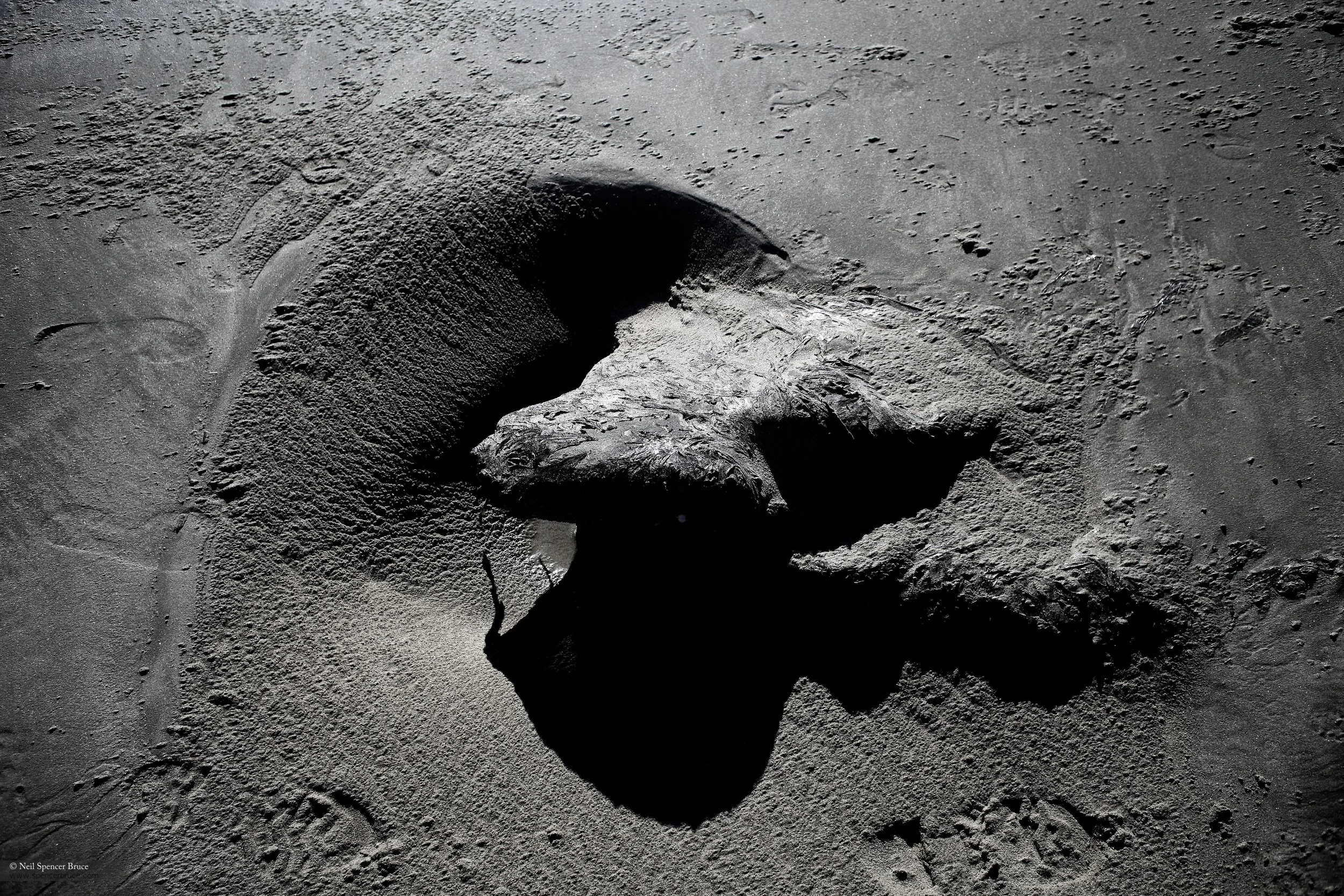
It has been a while since I have released a substantive project for one reason or another, but in 2026 I like to think that I am back. I guess there is a familiar narrative in contemporary music and art, that of the return, the reinvention, the or the rebrand (yuk!). But Driftworlds doesn’t quite fit that path for me, this is not simply a new beginning but I feel it is a reawakening of my artistic being after some time in the darkness. It is a realignment of what my creative existence actually is, a discovery of my voice and what it is that I am actually trying to say with my art.
Released under the new name of ‘The Listening Bureau’, the project proposes something closer to a system than a collection of albums or pieces. This is not just me expressing myself but the sense of a place or apparatus transmitting. The name itself purposefully suggests an ambiguity, TLB is part institution, part fiction, part method, part folklore, rooted in the ideas and place of Albion. I was drawn to the idea of a bureau, that slightly arcane modernist term, but one that listens, and also processes, archives, and redistributes. What is being transmitted is not just sound and music, but the conditions under which these becomes meaningful.
If there is an influence here, it lies somewhere in the long shadow of Mark Fisher’s hauntology, the eerie sense that the present is imbued with traces of futures that never arrived, ‘lost futures’ in his words. However, Driftworlds extends this beyond cultural theory into environmental perception. I want to ask the audience what does it mean to inhabit the landscapes and soundscapes of Albion which are already mediated, already encoded by infrastructure, planning, and signal? My approach is to think of this project dispersed across thirteen zones, a bit like the zones within Tarkovsky’s Stalker.
The System: Thirteen Environments
The Driftworlds is structured as a set of thirteen transmissions. These are not separate albums or ideas in the traditional sense, but types of experience, or if you like psychogeographic ways of encountering place as unstable, layered, and in flux. The Zones are :
Sea — littoral zones, erosion, signal drift
Underground — hidden systems, tunnels, persistence
Woodland — deep time, ecological memory, folklore
Estate — post-war housing, suspended futures
Urban — density, surface noise, present-tense overload
Motorway — flow, repetition, non-place
Industrial — decay, extraction, residual energy
Sacred — ritual space, temporal collapse
Transmission — broadcast, interference, hyperstition
Rural Edge — liminal countryside, encroachment
Void — abstraction, psychological space, absence
Edgelands — unclaimed territory, informal use
Transport — circulation, networks, continuous movement
Each transmission is equal. There is no centre, no hierarchy. Together I hope they will form a distributed map of Albion, not as geography, but as psychogeographic experience.
It starts with the sea
Well I guess it all started with the sea, yet if the system is non-hierarchical, why start here?
Because the sea is seemingly where systems begin to both begin and to break down. The seaside is the littoral zone, a shifting boundary between land and water which is inherently unstable yet calming. I feel that the sea edge resists fixed categorisation, as it erodes, deposits, obscures, yet builds, welcomes, immerses. You get the sense that signals behave differently here, scattering, fading, distorting, arriving when they see fit. Perhaps in one’s own mind, what was once clear becomes ambiguous.
The material that forms Transmission fmr:a01 has all emerged from coastal environments, through recordings and interpretations of sonic elements, from the wind, tide, sea to distant infrastructure. I don’t want the to be a soundscape or a field recording in the traditional sense, but something closer to a unique transmission: a work shaped by place, but no longer bound to it.
There is something quietly unsettling about the sea, and the lore and mythologies of Albion and it’s connection to the sea which surrounds us. The sea, which we often percieve as vast, ominous and yet natural, also becomes a site of mediation and communication, of cables, broadcasts, maritime routes, and submerged infrastructures. Even at the edge, there is no outside of the system.
These works are not a disappearance of the artist, but a redistribution of meaning. The “voice” if you will, of the work is no longer internally mine but experiential for all those who want to immerse themselves. At a time where everything is expected to be immediate, visible, and self-explanatory, there is something deliberately rebelious in my approach. I don’t want Driftworlds to explain itself fully but to emerge from prolonged attention.
There will thirteen transmissions from The Listening Bureau.
This sea the first.
The transmission are already in motion.